Finding the right landscape lighting installer isn’t like hiring someone to mow the lawn. It’s electrical work that lives outdoors, faces weather extremes, and needs to integrate with your home’s aesthetic and power system. A bad install means flickering fixtures, corroded connections, or transformer failures within a year. A good one transforms your yard into a usable, safe, and stunning space after dark while adding measurable curb appeal and security. Whether you’re lighting pathways, uplighting trees, or accenting architectural features, the difference between a pro and a handyman with a shovel shows up fast.
Table of Contents
ToggleKey Takeaways
- Professional landscape lighting service near me transforms your yard with low-voltage systems designed to last 10+ years while adding curb appeal and security, unlike DIY kits that often fail within a year.
- Verify that your landscape lighting installer holds proper licensing, carries $1 million general liability insurance, and possesses certifications like CLVLT to ensure compliance with industry standards.
- Request itemized written quotes from at least three companies that specify fixture brands, cable type, transformer specs, and labor costs—watch for vague line items and unusually low bids that indicate corner-cutting.
- Professional installers use design expertise and proven techniques like path lighting for safety, uplighting for drama, and moonlighting to create layered, glare-free outdoor spaces tailored to your home’s aesthetic.
- Ask detailed questions about transformer sizing, cable burial depth (6–8 inches with direct-burial rated cable), warranty coverage, and whether adjustment visits are included to ensure long-term performance.
- Avoid red flags such as companies with no local presence, pressure to sign same-day contracts, unwillingness to provide insurance documentation, or exclusive proprietary systems that lock you into ongoing vendor dependence.
Why Professional Landscape Lighting Makes a Difference
DIY landscape lighting kits from big-box stores seem tempting, plug-and-play stakes, solar options, and no electrician required. But professional installations use low-voltage systems (typically 12V or 24V) with properly sized transformers, burial-rated cable, and fixtures designed to last 10+ years in soil contact and UV exposure.
Pros understand load calculations. They’ll size your transformer correctly (usually 300W to 600W for residential jobs), account for voltage drop over cable runs, and use multi-tap transformers to balance brightness across zones. They also know how to avoid common mistakes: burying standard wire instead of direct-burial rated cable, overloading circuits, or placing transformers where moisture collects.
Beyond the electrical work, professionals bring design expertise. They know how to layer lighting, path lights for safety, uplights for drama, downlights for ambient fill, and they’ll position fixtures to avoid glare, light trespass onto neighbors’ properties, and harsh shadows. Expect them to use techniques like moonlighting (downlighting from trees), silhouetting (backlighting objects), and grazing (raking light across textured surfaces). These aren’t things you pick up from a YouTube video.
Finally, a licensed installer pulls permits when required (rare for low-voltage, but some jurisdictions regulate transformer placement near meters) and warranties their work. That means callbacks for adjustments, warranty coverage on fixtures, and someone to call when a raccoon digs up a junction box.
What to Look for in a Local Landscape Lighting Company
Start by confirming they specialize in landscape lighting, not general landscaping with lighting as a side gig. Dedicated lighting companies invest in training, carry manufacturer certifications (look for AOLP or CLVLT credentials), and stock commercial-grade fixtures rather than consumer-grade products.
Check how long they’ve been in business locally. Fly-by-night operators pop up every spring and vanish by fall. A company with 5+ years of local presence has relationships with suppliers, a portfolio of completed jobs you can drive by, and a track record with your municipality’s permitting office (if applicable).
Ask if they offer design consultations. Reputable companies will visit your property, often at dusk, to assess existing lighting, discuss goals, and sketch a lighting plan before quoting. This isn’t a 10-minute walkthrough, it’s an hour or more of evaluation. Some charge a design fee that’s credited toward installation: others include it free with project commitment.
Licensing, Insurance, and Certifications
Licensing requirements vary. Low-voltage landscape lighting (under 30V) often doesn’t require an electrician’s license, but some states mandate a contractor’s license or specialty low-voltage certification. Ask what licenses they hold and verify them with your state’s contractor licensing board.
General liability insurance is non-negotiable. Request a certificate of insurance (COI) naming you as additional insured. This protects you if they damage your irrigation system during trenching or a fixture causes a trip-and-fall injury. Minimum coverage should be $1 million per occurrence.
Workers’ compensation insurance matters if they have employees. Without it, you could be liable if a worker is injured on your property. Sole proprietors often don’t carry workers’ comp, but any company with a crew should.
Certifications like CLVLT (Certified Low Voltage Lighting Technician) or membership in the Association of Outdoor Lighting Professionals (AOLP) signal commitment to industry standards. These aren’t required, but they indicate ongoing education and adherence to best practices.
How to Compare Quotes and Service Packages
Get at least three written quotes. Each should itemize fixtures (brand, model, wattage), cable type and length, transformer specs, labor, and any site-specific work like trenching through hardscape or mounting on masonry.
Watch for vague line items like “materials” or “misc. supplies.” Quality installers specify everything: brass vs. composite fixture bodies, LED lamp type (integrated vs. replaceable bulbs), wire gauge (12 AWG or 10 AWG for long runs), and whether connectors are silicone-filled wire nuts or waterproof splice kits.
Compare warranty terms. Fixture warranties range from 1 to 15 years depending on brand and material. Labor warranties typically run 1 to 3 years. A company offering a 10-year fixture warranty but only 90 days on labor is betting you won’t call back, or won’t be able to find them.
Ask about maintenance packages. Landscape lighting needs seasonal adjustments: bulbs dim over time, fixtures shift as soil settles, and trees grow to block beams. Many companies offer annual service contracts (typically $150–$300/year) covering bulb replacement, aiming adjustments, and transformer checks. This is especially valuable if you’re not comfortable working with electrical systems.
Pricing varies widely by region and material quality, but expect $2,500 to $5,000 for a basic residential install (10–15 fixtures, one transformer, standard trenching). High-end projects with 30+ fixtures, architectural-grade brass housings, and complex zoning can exceed $10,000. If a quote seems unusually low, ask whether they’re using aluminum or plastic fixtures (which corrode or crack faster than brass or copper), 18-gauge wire (too light for most runs), or plug-in transformers (which limit placement options).
Questions to Ask Before Hiring a Landscape Lighting Pro
Start with the basics:
- “What brands do you install, and why?” Look for answers that reference durability, warranty, and availability of replacement parts. Companies that install only one obscure brand may be tied to a franchise or limited in design flexibility.
- “How do you size the transformer?” They should mention calculating total wattage, adding 20% overhead, and accounting for voltage drop. If they say “we always use a 300W transformer,” they’re guessing.
- “What’s your cable burial method?” Proper installs trench 6–8 inches deep and use direct-burial rated cable (UF or landscape lighting cable). Surface stapling or shallow burial invites damage from aerators and edgers.
- “Do you install junction boxes or use daisy-chain wiring?” Hub-and-spoke wiring (home runs from transformer to junction boxes, then to fixtures) is more reliable and easier to troubleshoot than daisy-chaining fixtures end-to-end.
- “What happens if a fixture fails after warranty?” Know whether they stock parts, how quickly they respond to service calls, and whether they charge trip fees for minor repairs.
- “Will you adjust lighting after installation?” Landscape lighting often needs tweaking once you see it at night from inside the house. Good installers include one or two adjustment visits in their bid.
Don’t skip the awkward questions:
- “Can I see photos of jobs from 3+ years ago?” This reveals how their work holds up. Ask for addresses (with permission) so you can drive by.
- “What’s your cleanup process?” Trenching creates a mess. Confirm they’ll haul away debris, reseed disturbed turf, and replace mulch.
- “Who will actually do the work?” If the owner sells the job but subcontracts installation, ask about the sub’s experience and insurance.
Popular Landscape Lighting Styles and Techniques
Understanding common techniques helps you communicate your vision and evaluate whether a company’s portfolio matches your style.
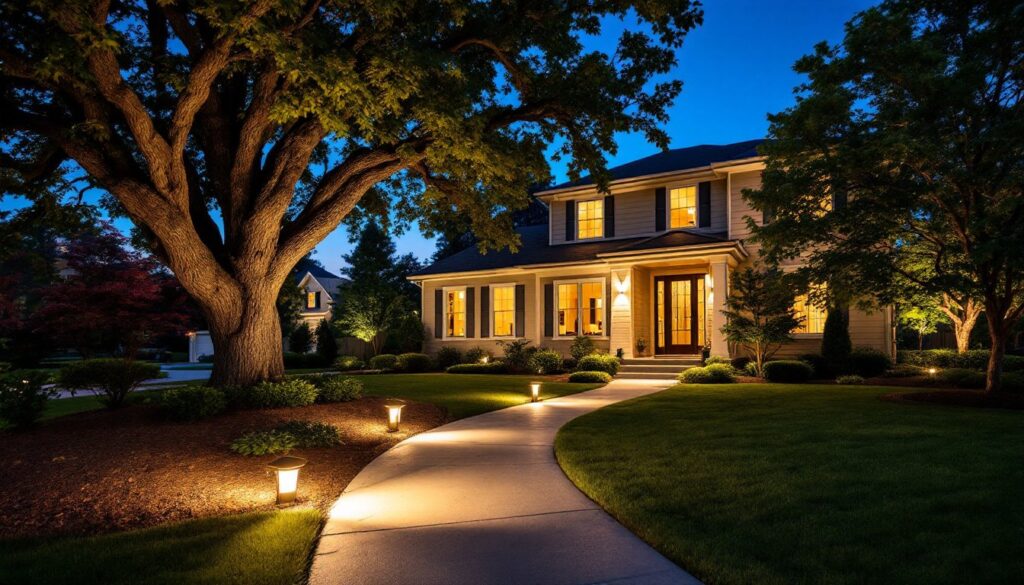
Path lighting uses low, shielded fixtures (typically 1.5–3W LEDs) spaced 8–10 feet apart along walkways. The goal is to light the path, not the fixtures. Avoid overly bright or unshielded path lights that create glare.
Uplighting places fixtures at the base of trees, walls, or architectural features, aiming upward. It’s dramatic but can be overdone. Pros use narrow beam spreads (10–20 degrees) for tall trees and wider spreads (30–60 degrees) for textured walls or shrubs. Overlapping beams from multiple angles creates depth.
Downlighting (moonlighting) mounts fixtures high in trees to cast dappled light downward, mimicking moonlight. This requires weatherproof fixtures and secure mounting, usually stainless steel straps or adjustable brackets that won’t girdle branches as trees grow. Some installers offer home electronics installation for integrated smart controls that sync landscape lighting with indoor systems.
Grazing places fixtures close to textured surfaces (stone walls, tree bark, stucco) to emphasize relief and shadow. It’s subtle and requires careful aiming.
Silhouetting backlights objects (sculptures, ornamental grasses) against a wall or fence, creating a dramatic outline. It works best with simple, recognizable shapes.
Shadowing positions a fixture in front of an object to cast its shadow onto a surface behind it. It’s theatrical and best used sparingly.
Color temperature matters. Most landscape lighting uses 2700K to 3000K (warm white), which complements brick, wood, and foliage. Cooler temperatures (4000K+) can look harsh and wash out greenery.
Red Flags to Avoid When Choosing a Service Provider
Some warning signs are obvious: others emerge during conversation.
No physical address or local phone number. National lead-gen companies like HomeAdvisor and ImproveNet connect you with contractors, but they don’t vet quality deeply. Always confirm you’re dealing with a local company, not a call center routing your request.
Pressure to sign same-day. Quality installers book weeks out, especially in spring and fall. A “today only” discount suggests they’re desperate for work, or they’re not very good.
Unwillingness to provide references or insurance. If they hesitate, walk away. Legitimate companies provide this information immediately.
Vague or incomplete proposals. “Landscape lighting package – $3,500” tells you nothing. You need fixture counts, brands, specs, and labor breakdowns.
Using line-voltage (120V) fixtures outdoors. This is a code violation in most jurisdictions unless installed by a licensed electrician with GFCI protection, weatherproof boxes, and conduit. Low-voltage is safer and more flexible for landscape use.
No transformer placement plan. The transformer needs to be accessible, protected from moisture, and within code-compliant distance from your electrical panel. If they don’t discuss this, they haven’t thought it through.
“We only work with this one brand, and we can’t tell you what it is until we start.” Proprietary systems lock you into one company for service and parts. You want fixtures from brands with wide distribution (FX Luminaire, Kichler, Hinkley, Volt, etc.).
Extremely low bids. If one quote is 40% below others, they’re either cutting corners (cheap fixtures, thin wire, shallow burial) or lowballing to win the job, then upselling once they start. Many landscape lighting professionals provide transparent pricing and detailed breakdowns to avoid surprises.
No mention of PPE or safety. Trenching near gas lines, irrigation, or buried electrical requires care. Ask if they hand-dig near utilities and whether they call 811 for locates before digging. This is legally required in all 50 states.
Trust your gut. If the installer seems disinterested during the consultation, doesn’t ask about your goals, or talks more about what’s easy than what’s right for your property, keep looking. Landscape lighting is a long-term investment, choose a partner who’ll still be around when you need them.