Antique pendant lighting doesn’t just illuminate, it adds character, warmth, and a story to any room. Whether it’s a salvaged Victorian fixture with original brass fittings or an industrial warehouse pendant from the 1940s, these pieces bring a layer of authenticity that reproduction fixtures can’t match. They work in nearly every style of home, from farmhouse kitchens to modern lofts, and they’re often better built than contemporary mass-market options. If you’re considering adding antique pendants to your space, understanding the styles, installation requirements, and placement strategies will help you choose fixtures that last another century.
Table of Contents
ToggleKey Takeaways
- Antique pendant lighting adds authentic character and superior durability compared to modern mass-market fixtures, with materials like brass, bronze, and glass that can outlast contemporary alternatives.
- Proper installation of antique pendants requires a secure ceiling box rated for the fixture’s weight (often 15–30 pounds) and compliance with local electrical codes to ensure safety.
- Victorian, Edwardian, and industrial warehouse styles of antique pendant lighting work across diverse home aesthetics, from farmhouse kitchens to modern lofts, offering design flexibility without limiting your décor.
- When selecting antique pendant lighting, prioritize scale to your room size, verify electrical and structural condition, and always replace outdated cloth-wrapped wiring with modern safe alternatives before installation.
- Strategic placement at 30–36 inches above countertops, islands, and dining tables maximizes task lighting and visual impact while maintaining code clearance and avoiding head strikes.
- Choosing antique pendants is an eco-friendly practice that salvages manufactured items from landfills, and with LED bulb compatibility, you can maintain vintage aesthetics while improving energy efficiency.
What Is Antique Pendant Lighting?
An antique pendant light is a hanging fixture typically manufactured between the 1880s and the 1960s, suspended from the ceiling by a chain, cord, or rigid rod. True antiques are at least 50–75 years old, though the term is often applied more loosely to vintage or vintage-inspired pieces.
These fixtures were built during eras when craftsmanship mattered, before planned obsolescence became standard. You’ll find hand-blown glass shades, cast brass or bronze fittings, porcelain sockets, and fabric-wrapped cords. Many were originally wired for gas or early electric systems, so rewiring is common (and necessary for safety).
Antique pendants differ from reproductions in materials and construction. Originals often show minor imperfections: slight variations in glass thickness, hand-finished metalwork, or patina that developed over decades. Reproductions tend to be more uniform and lighter in weight.
Before installation, check the fixture’s electrical box compatibility. Antique pendants can be heavy, some weigh 15–30 pounds with glass shades, and older ceiling boxes may not be rated for the load. If the existing box is plastic or nailed directly to lath, install a fan-rated metal box anchored to a joist or blocking. This is a code requirement in most jurisdictions and prevents the fixture from pulling free.
Why Choose Antique Pendant Lights for Your Home
Antique pendants offer durability that modern fixtures rarely match. Brass, bronze, and cast iron don’t degrade the way stamped steel or plastic does. Glass shades, unless cracked, are essentially permanent. With proper rewiring, these fixtures can outlast the homeowner.
They also provide design flexibility. An antique pendant doesn’t lock you into a single aesthetic. A 1920s schoolhouse globe works in a minimalist kitchen as easily as a traditional hallway. Industrial pendants suit both exposed-brick lofts and contemporary farmhouse spaces. The patina and material quality add visual weight without dominating the room.
From a practical standpoint, older fixtures often have larger shade openings that accommodate modern LED bulbs more easily than narrow contemporary designs. You can use vintage-style Edison bulbs for ambiance or standard A19 LEDs for efficiency.
Ecologically, choosing antique lighting is a form of salvage and reuse. You’re keeping a manufactured object in service instead of contributing to landfill waste. That said, older wiring, cloth-wrapped or knob-and-tube style, must be replaced. Don’t reuse original cords or sockets unless they’ve been inspected and deemed safe by a licensed electrician. Safety always trumps authenticity.
Popular Styles of Antique Pendant Lighting
Victorian and Edwardian Pendants
Victorian-era pendants (roughly 1880s–1901) and Edwardian fixtures (1901–1910) are ornate, often featuring etched or frosted glass shades, polished brass chains, and decorative ceiling canopies. Common shade shapes include bell, dome, and tulip profiles.
These fixtures were designed for gas or early electric lighting and typically hung lower than modern standards, sometimes just 60–65 inches from the floor in dining rooms. If you’re installing one over a table or island, raise it to a modern height of 30–36 inches above the surface to avoid head strikes and improve light distribution.
Victorian pendants often have multiple finish layers: nickel plating over brass, or painted enamel details. When cleaning, avoid abrasive compounds that strip original finishes. Use a soft cloth and mild detergent, and leave patina intact unless it’s actively corroding.
Industrial and Warehouse Fixtures
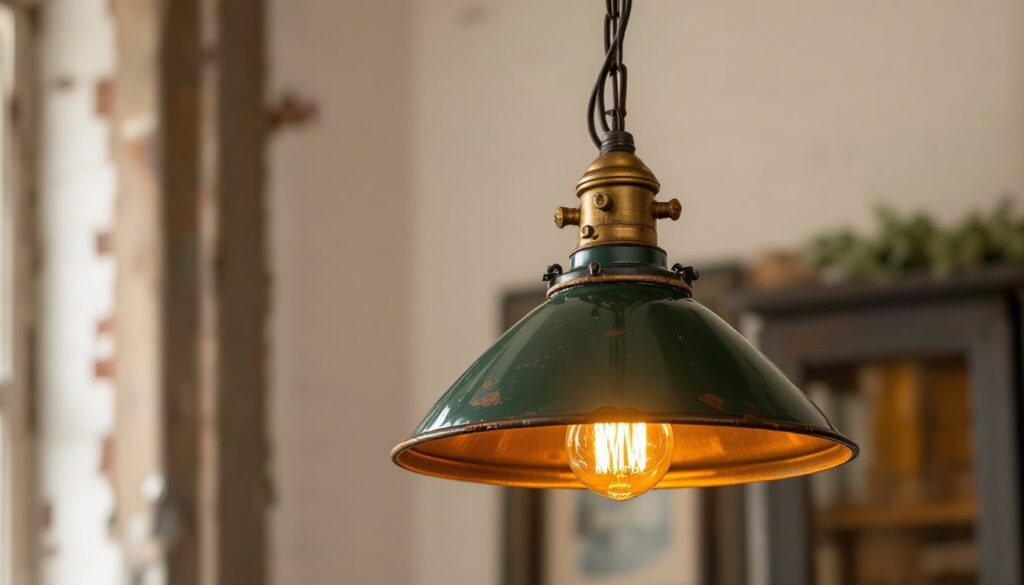
Industrial pendants from the 1920s–1950s were built for factories, warehouses, and commercial kitchens. They’re characterized by enamel-coated steel shades (often in dark green, white, or black), exposed sockets, and simple chain or cord mounts. Many feature deep, conical or dome shades designed to direct light downward onto work surfaces.
These fixtures are heavy-duty. Enamel finishes are baked on and highly durable, though they can chip if struck. Surface rust on the interior is common and cosmetic: structural rust on mounting hardware should be addressed before installation.
Industrial pendants pair well with modern design inspiration trends that emphasize raw materials and utilitarian forms. They work especially well in kitchens, over islands, or in open-plan spaces where you need focused task lighting without fuss.
Where to Use Antique Pendant Lighting in Your Home
Kitchens and islands are the most common application. A pair or trio of industrial pendants provides task lighting and visual interest. Hang them 30–36 inches above the countertop, centered over the work surface. Space multiple fixtures 24–30 inches apart to avoid crowding.
In dining rooms, a single large pendant or a cluster of smaller ones works well. The bottom of the shade should sit roughly 30–34 inches above the table surface, low enough to create intimacy but high enough to avoid blocking sightlines. Many dining room light fixtures emphasize vintage brass or glass elements that complement antique pieces.
Entryways and stairwells benefit from antique pendants with 360-degree light output, like globe or lantern styles. In two-story entries, ensure the bottom of the fixture is at least 7 feet above the floor to meet code clearance and avoid head strikes.
For bedrooms, smaller pendants can replace bedside table lamps, freeing up surface space. Mount them 18–24 inches out from the wall and 24–30 inches above the mattress top. Use a dimmer switch for flexibility, most antique fixtures are compatible with standard incandescent or dimmable LED bulbs.
Bathrooms require special consideration. If the fixture will be within 3 feet of a tub or shower (Zone 1 or 2 per NEC standards), it must be rated for damp or wet locations. Most antique fixtures are not. Keep them outside splash zones and ensure all wiring is GFCI-protected.
How to Choose the Right Antique Pendant Light
Start with scale. Measure the room and the surface you’re lighting. A pendant that’s too small disappears: too large, and it overwhelms. For a dining table, add the room’s length and width in feet, then convert to inches, that’s a good starting shade diameter. A 12×14-foot room suggests a fixture around 26 inches wide.
Ceiling height dictates chain or cord length. Standard 8-foot ceilings leave limited room: you may need to shorten the chain or use a low-profile canopy. For 9–10-foot ceilings, you have more flexibility. Always leave at least 7 feet of clearance below the fixture.
Inspect the condition before buying. Check for cracks in glass, loose or missing parts, and the state of the wiring. Original cloth-wrapped wiring is a fire hazard and must be replaced. If you’re not comfortable rewiring, hire a licensed electrician, this isn’t the place to learn on the job.
Consider the finish. Patina on brass or bronze is desirable and adds character. Active corrosion, flaking paint, or rust that compromises structural integrity is not. Enamel finishes can be touched up with appliance epoxy paint if chips are minor.
Finally, think about light output and bulb compatibility. Antique sockets are often rated for lower wattages (40–60W incandescent). If you’re using LED bulbs, match the lumen output to your needs, not wattage. A 10W LED can produce the same light as a 60W incandescent. Check that the shade opening accommodates your chosen bulb shape, especially if you’re using vintage-style Edison bulbs.
For spaces inspired by luxury home design aesthetics, mixing antique and contemporary elements creates layered, sophisticated interiors without feeling overly themed. Let the pendant be a focal point, but balance it with simpler surrounding fixtures and finishes.