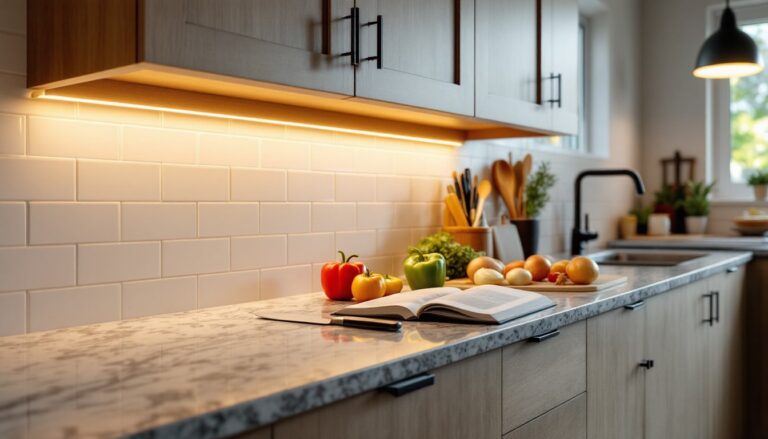
Small kitchens pack a lot of function into minimal square footage, and lighting can make or break how well the space works. Poor lighting leaves corners in shadow, makes prep work harder, and shrinks an already tight room. Smart lighting, on the other hand, opens up the space, improves safety, and turns a cramped galley into a surprisingly workable kitchen. The good news? Even renters and DIYers with basic electrical skills have plenty of options that don’t require tearing into walls. From strategic under-cabinet strips to carefully placed pendants, the right mix of fixtures transforms both the look and usability of a small kitchen.
Table of Contents
ToggleKey Takeaways
- Smart kitchen lighting ideas for small kitchens layer ambient, task, and accent light sources to eliminate shadows, improve safety, and make the space feel larger.
- Under-cabinet LED strip lighting is the easiest DIY upgrade that removes shadows and provides continuous task lighting for food prep without requiring an electrician.
- Properly positioned pendant lights with 6- to 8-inch shades hung 30–36 inches above counters add style and task lighting while preserving sightlines in compact spaces.
- Recessed lighting spaced 4 feet apart (based on ceiling height) combined with warm white bulbs (2700K–3000K) creates inviting ambient light without consuming floor or headroom.
- Dimmer switches and color temperature choices (warm for ambient, neutral-white for task) let you shift small kitchen lighting from bright meal-prep mode to relaxing dining ambiance.
- Accent lighting like toe-kick strips and above-cabinet LEDs draw the eye upward, making small kitchens feel taller while adding depth without visual clutter.
Why Lighting Matters More in Small Kitchens
In compact kitchens, every inch counts, and that includes vertical space and sight lines. Inadequate or poorly positioned lighting creates dead zones where cabinets cast shadows over counters, making knife work risky and food prep frustrating. Dark corners also make small spaces feel even smaller, triggering that claustrophobic vibe no one wants in a room where they spend significant time.
Good lighting does three jobs at once. Ambient lighting fills the room with general illumination. Task lighting targets work surfaces, counters, sinks, stovetops, where you need to see clearly. Accent lighting highlights architectural details or open shelving, adding visual interest without clutter. Small kitchens benefit more from layered lighting than large ones because there’s less room for error: a single overhead fixture rarely cuts it.
Another factor: resale and rental appeal. Updated, thoughtful lighting signals that a kitchen is well-maintained. Buyers and renters notice dark, dingy kitchens immediately. Swapping outdated fixtures or adding under-cabinet LEDs can return several times the investment in perceived value, even in a 60-square-foot kitchen.
Layered Lighting: The Foundation of Great Small Kitchen Design
Layering light sources prevents the one-light-fits-all trap. Start with ambient lighting, typically a flush-mount or semi-flush ceiling fixture that spreads light evenly. In small kitchens, a single 12- to 15-inch diameter fixture with a diffused shade works well for spaces up to about 80 square feet. For narrow galley kitchen layouts, consider two smaller fixtures spaced evenly to eliminate shadows along the length of the room.
Next, add task lighting where you actually work. Countertops, the sink, and the range all need dedicated light. This is where under-cabinet lighting, pendants, and directional fixtures come into play. Task lights should deliver 300 to 500 lumens per square foot of work surface, bright enough to see onion layers without squinting.
Finally, accent lighting adds dimension. In small kitchens, this might mean interior cabinet lighting that showcases glassware, LED strips above upper cabinets that wash the ceiling with light, or a single spotlight on a floating shelf. Accent fixtures don’t need high wattage: 50 to 100 lumens per accent is plenty. The goal is depth and interest, not floodlight intensity.
Under-Cabinet Lighting Solutions
Under-cabinet lighting is the MVP of small kitchen task lighting. It eliminates the shadow your body casts when overhead lights are the only source, and it’s one of the easiest upgrades for renters and DIYers alike.
Puck lights are small, round fixtures mounted individually under cabinets. Battery-powered or plug-in versions install without an electrician, but they create small pools of light rather than continuous coverage. They work best for highlighting specific zones, like a coffee station.
LED strip lights (also called tape lights) provide seamless, even illumination along the full length of a cabinet run. Hardwired versions require basic electrical work, connecting to an existing switch or installing a new one, but plug-in kits with adhesive backing take minutes to install. For low-ceiling kitchens, strips mounted toward the front edge of the cabinet prevent light from spilling upward and creating glare.
Linear fixtures look like slim bars and deliver the most polished, built-in appearance. They’re a step up from tape lights in terms of output and durability. Hardwired versions often come with a remote driver (the transformer that steps down voltage) that mounts inside the cabinet, keeping the fixture profile low. Expect to pay $30 to $60 per linear foot installed if you hire an electrician, or DIY for about half that using plug-in models.
Safety note: If hardwiring anything, shut off power at the breaker and use a non-contact voltage tester before touching wires. Most jurisdictions don’t require permits for low-voltage LED installations, but always check local codes.
Pendant Lights That Save Space and Add Style
Pendant lights get a bad rap in small kitchens because poorly chosen fixtures eat up visual space or hang too low. But the right pendants, mini pendants with 6- to 8-inch shades, add style and task lighting without crowding sight lines.
Hang pendants 30 to 36 inches above a counter or eating bar to keep them out of the way while directing light downward. In tight spaces, a single centered pendant over a small island or peninsula works better than a row of three. If you don’t have an island, consider a pendant over the sink in place of a recessed can: it adds character and focuses light exactly where you wash dishes and prep vegetables.
Glass or open-frame pendants feel lighter than solid metal or opaque shades. Clear glass or wire cage designs let light spill in multiple directions, doing double duty as ambient and task lighting. According to Remodelista’s curated guide, minimalist pendants with clean lines prevent a small kitchen from feeling overly decorated.
Installation is straightforward if you’re replacing an existing fixture: turn off power, disconnect the old fixture, connect the new pendant’s wires (black to black, white to white, ground to ground), secure the canopy, and install the bulb. If you’re adding a pendant where none existed, you’ll need to run electrical cable through the ceiling, likely a job for a licensed electrician unless you’re comfortable with junction boxes and NEC requirements.
Recessed and Track Lighting for Maximum Flexibility
Recessed cans (also called downlights or pot lights) are the workhorse of small kitchen ambient lighting. They sit flush with the ceiling, preserving headroom and keeping the space uncluttered. Standard 4-inch or 6-inch cans work in most kitchens: smaller 3-inch cans fit between joists when spacing is tight.
Spacing matters. A common rule: divide ceiling height by two to get spacing in feet. For an 8-foot ceiling, that’s 4-foot spacing. In a small kitchen, plan on one recessed light per 25 to 30 square feet of floor area for ambient coverage, plus additional cans over work zones. Many recessed lighting layouts use a perimeter approach, placing cans 18 to 24 inches from the wall to light counters and cabinets without creating harsh overhead shadows.
Retrofitting recessed lights into an existing ceiling requires cutting holes, running cable, and potentially dealing with insulation and fire-rated housings (IC-rated cans for insulated ceilings, AT-rated for attics). If ceiling access is limited, surface-mount downlights or retrofitted LED modules that clip into existing fixtures offer an easier path.
Track lighting provides adjustable, directional light that’s perfect for small kitchens with unusual layouts or changing needs. Modern low-profile tracks are far from the industrial look of the ’90s: sleek single-circuit tracks with gimbal heads can highlight a backsplash, wash a wall with light, or spotlight a prep area.
Most track systems run on 120V, so installation involves connecting to a ceiling junction box just like a standard fixture. The advantage: once installed, you can slide track heads along the rail and rotate them as needed. This flexibility is gold in small kitchens where furniture or appliances might move over time. One caution, don’t overload a track. A 15-amp circuit supports about 1,800 watts, but in practice, keep the total wattage of all track heads under 1,200 watts to avoid tripping breakers.
Creative Accent and Decorative Lighting Ideas
Accent lighting in a small kitchen isn’t about adding more fixtures, it’s about using light to create depth and draw the eye upward, which makes the room feel taller. Toe-kick lighting, LED strips installed under base cabinets just above the floor, adds a soft glow that guides movement at night without the glare of overhead lights. It’s practical for midnight snack runs and visually grounds cabinetry, making it appear to float.
In-cabinet lighting showcases open shelving or glass-front cabinets. Battery-powered puck lights or small LED strips placed inside cabinets highlight dishware and décor while breaking up the visual mass of cabinetry. On sites like Homify, designers often use in-cabinet lighting to add warmth to modern, minimalist kitchens where every detail counts.
Above-cabinet lighting washes the ceiling with indirect light, making the room feel taller. This works especially well if there’s a gap between cabinet tops and the ceiling. Run an LED strip along the top of the cabinets, aimed upward. Choose warm white LEDs to avoid the harsh blue cast of daylight bulbs in a space meant to feel inviting.
One underused trick: dimmer switches. Even budget LED fixtures often work with standard rotary or slide dimmers (check bulb and dimmer compatibility first). Dimming shifts the mood from bright task mode during meal prep to softer ambient light during dinner. In a small kitchen doubling as a dining area, that flexibility matters.
Choosing the Right Bulbs and Color Temperature
Bulb choice affects how colors look, how awake you feel, and how much energy you spend. LEDs dominate the market for good reason: they last 15,000 to 50,000 hours, use a fraction of the energy of incandescent bulbs, and now come in every shape and color temperature imaginable.
Color temperature is measured in Kelvins (K). For kitchens, most designers recommend 2700K to 3000K (warm white) for ambient and accent lighting: it’s close to the color of traditional incandescent bulbs and feels inviting. Task lighting over counters can go slightly cooler, 3500K to 4000K (neutral white), to improve visibility without the sterile feel of daylight bulbs (5000K+). Mixing temperatures is fine as long as you keep ambient and task layers distinct: just avoid using 2700K and 5000K in the same fixture.
Lumens measure brightness. A 60-watt incandescent bulb produces about 800 lumens. For small kitchen ambient fixtures, look for bulbs delivering 1,200 to 1,600 lumens total. Task lights (under-cabinet, pendants) should hit 400 to 600 lumens per fixture, depending on the work area size. If you’re aiming for bright, energizing kitchen lighting throughout, lean toward the higher end of these ranges.
CRI (Color Rendering Index) matters if you care about how food looks. A CRI of 80+ is decent: 90+ is excellent and shows colors accurately. This is especially useful in a kitchen where you’re judging when a steak is medium-rare or whether herbs are fresh.
Bulb shapes and bases: For recessed cans, use BR30 or BR40 bulbs (the number indicates diameter in eighths of an inch). For pendants and decorative fixtures, A19 bulbs (standard shape) or globe bulbs work. Most screw into E26 medium bases. Under-cabinet LED strips are integrated, no bulb replacement, but check for linkable vs. non-linkable models if you need to cover more than one cabinet section.
Safety reminder: When replacing bulbs, make sure the fixture is off and cool. For hardwired installations or anything involving junction boxes, always follow NEC guidelines and consider hiring a licensed electrician if you’re unsure. Local codes vary, and some jurisdictions require permits even for adding new circuits or fixtures.
Finally, match your lighting fixtures to the bulb specs. Not all LEDs are dimmable, and pairing a non-dimmable bulb with a dimmer switch causes flickering or early failure. Check packaging for compatibility, and when in doubt, test one bulb before buying a dozen.