Most living rooms suffer from a single overhead fixture doing all the work, casting harsh shadows, creating dead zones, and making the space feel flat. If flipping on one switch determines whether the room feels like an interrogation cell or a cave, it’s time to rethink the approach. Good lighting isn’t about brightness alone: it’s about control, layering, and intentionality. This guide breaks down the fundamentals of living room lighting, from the three-layer framework professionals use to fixture selection and smart controls that let homeowners fine-tune their space throughout the day.
Table of Contents
ToggleKey Takeaways
- Good lighting for living room design relies on three independent layers—ambient, task, and accent—each serving distinct purposes to avoid harsh shadows and create balanced illumination.
- Proper ambient lighting requires distributing multiple fixtures (recessed cans spaced 4-5 feet apart, pendants, or track lighting) rather than relying on a single overhead fixture to eliminate dark corners.
- Task lighting should provide 300-500 lumens at work areas like reading chairs, with floor lamps positioned at shoulder height to prevent eye strain without creating glare.
- Dimmer switches and smart controls allow homeowners to adjust brightness and color temperature (warm 2700K for evenings, cooler tones for task work) throughout the day without rewiring.
- Fixture selection should match room size and ceiling height—small rooms need scaled fixtures like flush mounts and table lamps, while vaulted ceilings benefit from adjustable pendants to bring light closer to seating areas.
- Accent lighting highlights architectural features or artwork at a 30-degree angle and should be 2-3 times brighter than ambient light to create visual depth and focal points.
Why Living Room Lighting Matters More Than You Think
Living room lighting affects everything from how well someone can read on the couch to whether guests feel welcome after sunset. Poor lighting creates eye strain, limits usability, and makes even well-furnished rooms feel uncomfortable.
From a practical standpoint, the living room serves multiple functions: reading, watching TV, entertaining, working, and relaxing. Each activity demands different light levels and directions. A single central ceiling fixture provides general illumination but can’t address the specific needs of someone threading a needle versus someone hosting a movie night.
Design publications like House Beautiful regularly emphasize that lighting is the quickest way to change a room’s mood without moving furniture or repainting. Proper lighting also affects perceived room size, layered sources make spaces feel larger and more three-dimensional than flat overhead washes.
From a safety perspective, unlit walkways and dark corners increase trip hazards, particularly for older adults or anyone navigating the room at night. Building codes don’t mandate specific living room lighting (they’re more concerned with egress and hallways), but thoughtful placement reduces accidents and improves everyday functionality.
Understanding the Three Layers of Living Room Lighting
Professional designers and electricians organize lighting into three categories: ambient, task, and accent. Each layer serves a distinct purpose, and rooms feel most balanced when all three are present and independently controllable.
Ambient Lighting: Your Room’s Foundation
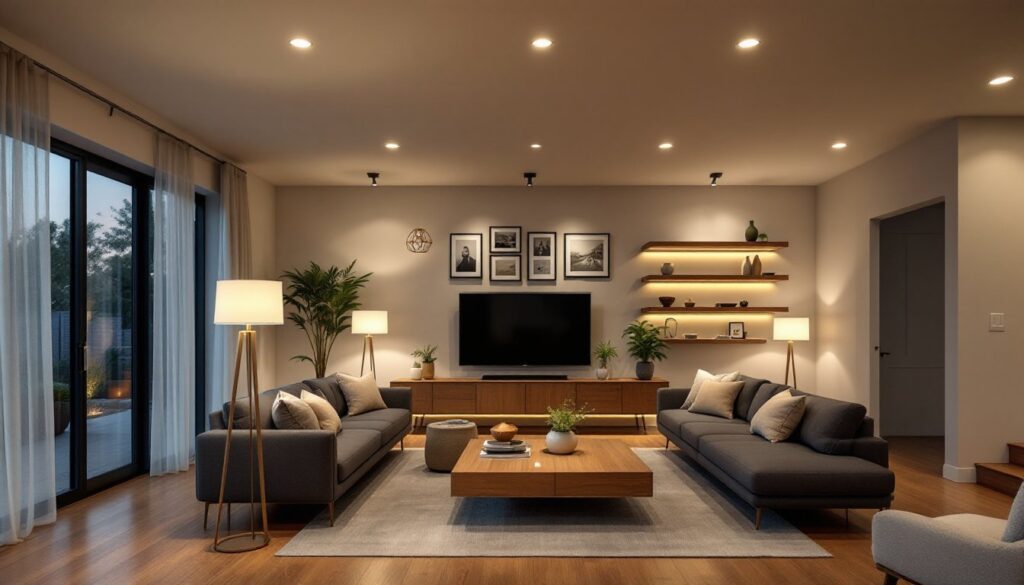
Ambient lighting provides overall illumination, the baseline that lets someone move safely through the space and see the room’s general layout. This layer typically comes from ceiling-mounted fixtures: flush mounts, semi-flush mounts, recessed cans, or chandeliers.
For a living room with 8-foot ceilings, recessed lighting should be spaced roughly 4 to 5 feet apart to avoid dark patches. Use 5- or 6-inch housings with LED retrofit kits rated for at least 650-800 lumens per fixture. Rooms with higher ceilings can accommodate pendant fixtures or chandeliers: hang them so the bottom sits 7 feet above the floor to avoid head clearance issues.
Many homeowners default to a single central fixture, which creates a hotspot in the middle and dim corners. Distributing ambient sources, whether through multiple recessed cans, a ceiling fan with an integrated light kit, or track lighting, delivers more even coverage. If retrofitting recessed cans into an existing ceiling, expect to cut drywall and fish wire: this is manageable for experienced DIYers but often faster when handled by a licensed electrician, particularly if the ceiling is finished plaster.
Task Lighting: Focused Illumination Where You Need It
Task lighting directs light onto specific work areas: reading chairs, side tables, desks, or craft zones. This layer prevents eye strain and makes activities like sewing, writing, or using a laptop more comfortable.
Common task fixtures include floor lamps, table lamps, and swing-arm wall sconces. For reading, aim for 300-500 lumens at the page or screen level, enough to see clearly without glare. Adjustable fixtures let users redirect light as needed: a three-way bulb (50/100/150W equivalent in LED terms: roughly 500/1100/1600 lumens) offers flexibility for different tasks.
When placing a floor lamp next to a sofa or armchair, position it so the bottom of the shade sits at shoulder height when seated: this keeps light out of eyes while illuminating the lap or side table. Wall-mounted swing-arm sconces save floor space and work well in tighter layouts, especially near built-in seating. Wire these during construction or renovation: retrofitting requires cutting into walls and connecting to an existing circuit. Always follow NEC (National Electrical Code) guidelines for junction box support and wire gauge, typically 14 AWG for 15-amp circuits or 12 AWG for 20-amp circuits.
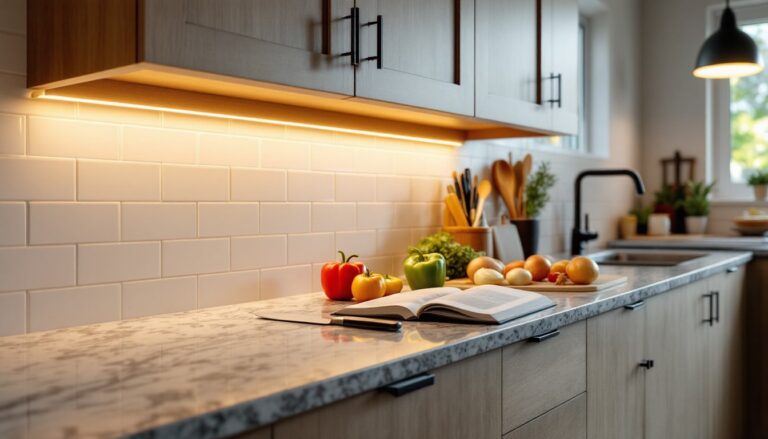
Kitchen lighting principles apply here too: just as task lighting over the sink addresses focused needs, living room task fixtures should target the activity zone without flooding the whole room.
Accent Lighting: Adding Drama and Dimension
Accent lighting highlights architectural features, artwork, or objects, creating visual interest and depth. This layer is optional from a functional standpoint but elevates the room’s design significantly.
Track lighting, picture lights, LED strip lights, and wall washers are common accent sources. Use them to graze textured walls, illuminate bookshelves, or spotlight a gallery wall. For artwork, position fixtures at a 30-degree angle from the piece to minimize glare and shadows: dedicated picture lights mounted above the frame work well for smaller pieces, while adjustable track heads suit larger installations.
LED strip lights installed along the top of crown molding or behind floating shelves create a soft glow that adds dimension without glare. Look for strips rated IP20 for indoor use, with color temperatures between 2700K and 3000K to match incandescent warmth. These run on low-voltage DC power, requiring a transformer: if running more than 16 feet, add an amplifier to prevent voltage drop and dimming at the far end.
Accent lighting should be two to three times brighter than ambient light on the object being highlighted. This contrast draws the eye and establishes focal points.
Choosing the Right Light Fixtures for Your Living Room Layout
Fixture selection depends on ceiling height, room size, furniture arrangement, and architectural features. There’s no one-size-fits-all formula, but a few guidelines help narrow the field.
For small living rooms (under 150 square feet), avoid oversized chandeliers or heavy pendants that overwhelm the space. Instead, use a combination of flush-mount ceiling fixtures and portable lamps. A single flush mount in the center provides ambient light, while a pair of table lamps flanking a sofa handles task needs. This mirrors strategies used in compact spaces like small kitchen lighting, where fixture scale matters as much as light output.
Large, open-plan living rooms benefit from multiple ambient zones. Consider a chandelier or large pendant over a central seating area, supplemented by recessed cans around the perimeter. If the room has a vaulted or cathedral ceiling, use pendant fixtures with adjustable cables or rods to bring light down closer to the living plane: otherwise, fixtures mounted 12+ feet overhead won’t provide usable task light at seating level.
Layout tips:
- For sectional sofas: Place floor lamps or end table lamps at both ends, so light reaches anyone seated. A single central lamp leaves outer seats in shadow.
- For rooms with TVs: Avoid fixtures that reflect in the screen. Position lamps or sconces to the sides or behind the seating area: dimmable bulbs let viewers reduce light during movies without going completely dark.
- For rooms with fireplaces: Treat the mantel as a focal point. Use accent lighting (picture lights, recessed spots, or LED strips in the mantel recess) to highlight artwork or decorative objects above the hearth.
When selecting fixtures, match the style to the room’s architecture. A mid-century modern space pairs well with sputnik chandeliers or sculptural floor lamps: a traditional room calls for crystal chandeliers, candlestick sconces, or ginger jar lamps. But don’t let aesthetics override function, beautiful fixtures that cast inadequate or poorly directed light will frustrate daily use.
Material choices also matter. Metal and glass fixtures are easier to clean and more durable than fabric shades in high-traffic areas. If using fabric, check that shades are UL-listed for the bulb wattage installed: overheating can scorch fabric or, in extreme cases, pose a fire risk.
For rooms with low ceilings (under 8 feet), recessed lighting or flush mounts are the safest bet. Hanging fixtures create a claustrophobic feel and increase the risk of head bumps. The same principle applies in low-ceiling kitchens, where vertical clearance dictates fixture type.
Smart Living Room Lighting: Dimming, Color Temperature, and Control Options
Smart controls transform static lighting into a flexible system that adapts to time of day, activity, and mood. This doesn’t require a complete rewire, many solutions retrofit into existing fixtures.
Dimmer switches are the simplest upgrade. Replace standard toggle switches with LED-compatible dimmers: older dimmers designed for incandescent bulbs can cause LED flicker or buzzing. Look for models rated for the total wattage on the circuit. For a living room with five 10W LED recessed cans (50W total), a standard 150W-rated dimmer provides plenty of headroom. Install dimmers on ambient and accent layers: task lighting often works best at full brightness.
Dimming serves multiple purposes: it reduces glare for TV watching, creates a relaxed evening atmosphere, and extends bulb life. Most LEDs dim smoothly down to 10-20% output, though performance varies by bulb brand.
Color temperature affects the room’s feel more than most homeowners realize. Measured in Kelvins (K), lower numbers (2700K-3000K) produce warm, yellowish light similar to incandescent bulbs, while higher numbers (4000K-5000K) shift toward cool, blue-white light. Living rooms typically feel cozier with warm tones: reserve cool whites for task areas where color accuracy matters (art studios, home offices).
Tunable white bulbs let users adjust color temperature via app or remote. Set bulbs to 2700K for evening relaxation and 3500K for daytime reading. Some systems mimic natural daylight cycles, gradually cooling light in the morning and warming it at night to support circadian rhythms.
Smart bulbs (Philips Hue, LIFX, Wyze) screw into existing sockets and connect via Wi-Fi or Zigbee. They offer dimming, color temperature control, and in some cases, full RGB color. Pair them with voice assistants (Alexa, Google Assistant) or schedule them to turn on/off automatically. Smart bulbs work well in lamps and fixtures controlled by pull chains or where installing a smart switch isn’t practical.
Smart switches (Lutron Caséta, Leviton Decora) replace existing wall switches and control any bulbs on that circuit, no need to buy expensive smart bulbs. This approach costs less per fixture in rooms with multiple recessed cans or track heads. Installation requires basic electrical skills: shut off the circuit breaker, disconnect the old switch, connect line/load/ground wires to the new switch per manufacturer instructions, and restore power. If the existing box lacks a neutral wire (common in older homes), choose a smart switch that doesn’t require one (Lutron Caséta, for example) or have an electrician pull a neutral.
Interior design resources like MyDomaine often showcase living rooms where lighting layers adjust throughout the day, demonstrating how control systems enhance both function and atmosphere.
For whole-room control, hubs like Samsung SmartThings or Hubitat integrate switches, bulbs, sensors, and thermostats into a single system. Motion sensors automatically turn on entryway lighting when someone enters: daylight sensors dim fixtures when natural light is sufficient, saving energy.
Safety and code notes: Any work involving permanent wiring, switch replacement, new circuits, or fixture installation, must comply with local electrical codes. Many jurisdictions require permits and inspections for new circuits or junction boxes. Hire a licensed electrician if unsure: improper wiring poses shock and fire hazards. Always use UL-listed devices and follow torque specs when tightening wire nuts and terminal screws.
For inspiration on kitchen lighting control systems, many of the same smart fixture principles apply to living rooms: layering, independent control, and integration with home automation platforms. Similarly, bright ambient strategies used in kitchen lighting design translate well to living spaces that double as home offices or craft zones.